If you've ever slipped on a pair of wedges and thought, “Wait—why do these actually feel fine?”—you're not imagining things.
The comfort is real. It's just not always easy to explain.
Most of us have heard vague things about weight distribution or heel height, but it never quite clicks. So here's what's actually happening—no jargon, no anatomy lecture—just a straightforward breakdown of why your body responds so differently to a wedge sole versus a stiletto or block heel.
When you stand in flat shoes—or barefoot—your weight spreads across your entire foot. Your heel, your arch, the ball of your foot, your toes. They all share the load. It's not glamorous, but it works well.
Classic heels, by contrast, shift almost all of that weight onto the ball of your foot. The higher the heel, the more dramatic the tilt—and the harder that small front section works. That's where the ache comes from. Not weakness, not bad posture. Just physics.
Wedges change this equation. Because the sole runs as a continuous solid unit from heel to toe, your weight has somewhere to go. It spreads. The pressure doesn't pile up in one spot—it travels across a larger surface area. Your foot gets a much fairer deal.
Think of it like this: standing in stilettos is a bit like balancing a tray on one finger. Wedge sandals are more like resting it across your whole palm. Same tray, same weight—completely different experience.
In a traditional heel, your ankle is suspended at an angle. To keep you upright, your calves engage constantly—almost like they're bracing for impact. After a while, they don't so much ache as clench. That low-level tension is your body working overtime just to keep you balanced.
With wedges, your ankle sits in a more neutral position. There's still a lift, yes—but the sole beneath you is stable and even. Your calf muscles don't have to grip as hard because the shoe itself is doing some of that steadying work. It's a quiet collaboration between your foot and the footwear.
This is also why you can wear wedges for hours in a way that classic heels rarely allow. The muscular effort required is simply lower.
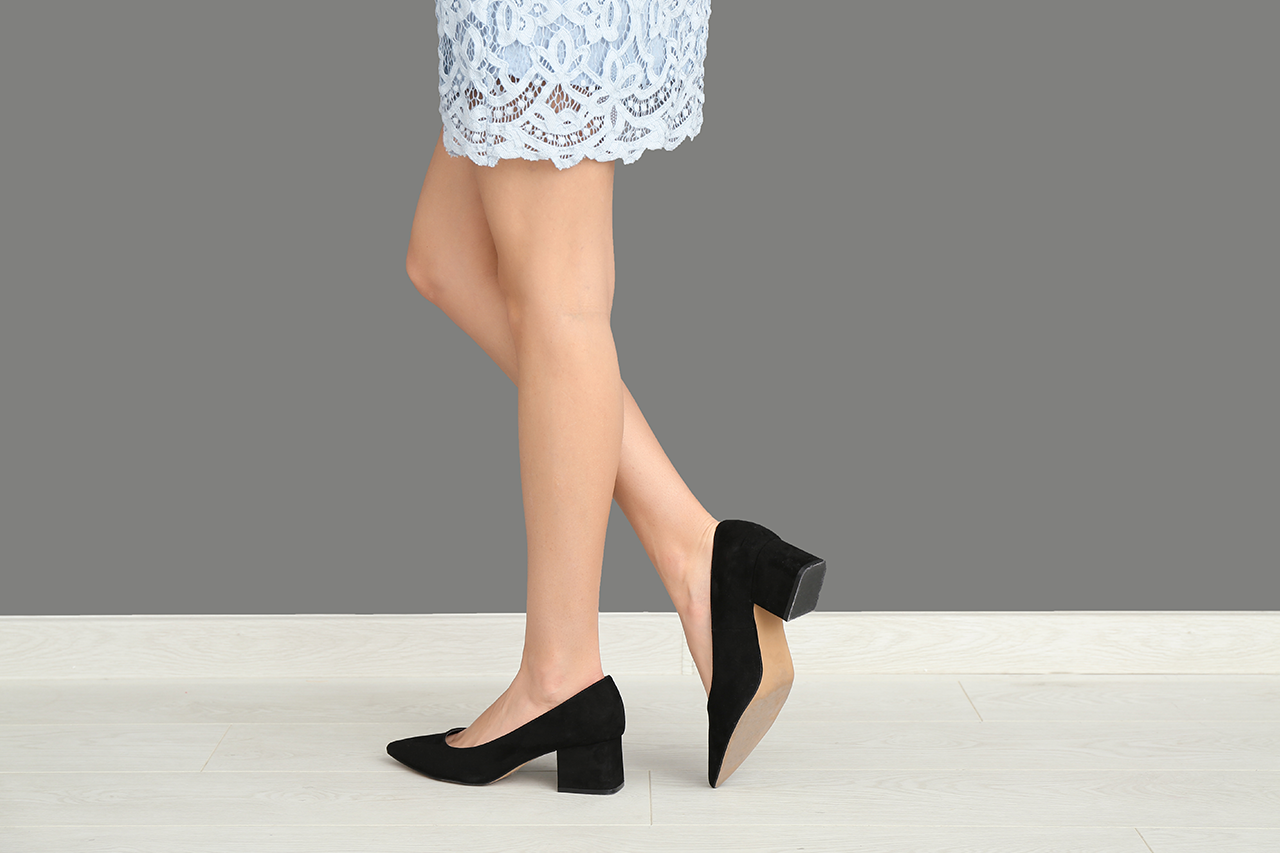
Your body is one long connected chain. When your foot tilts sharply, your ankle adjusts. Then your knee. Then your hip. Then your lower back. Each joint compensates for the one below it, and those compensations add up over the course of a day.
Steep heels push your pelvis forward and create an exaggerated curve in the lower spine. Some people find this flattering in the mirror. Their backs find it less charming by evening.
Wedge shoes produce a much gentler tilt. The incline exists—which is part of what makes them look elevated and polished—but it doesn't set off that same chain reaction through your joints. Your posture stays closer to its natural alignment. Less to compensate for means less to feel at the end of the day.
It's worth noting that leather wedges, in particular, tend to hold their shape over time in ways that synthetic soles may not. A sole that maintains its structure means consistent support—and that matters more than most people realise.
Ask anyone who has rolled their ankle in heels and they'll tell you exactly how that conversation goes with the ground.
Narrow heel points create a small and unstable base. Your ankle is essentially balancing on a post—any slight misstep, any uneven pavement, any moment of distraction, and you're done.
Wedges sit flat. The entire length of the sole is in contact with the ground at once. There's no pivot point to roll off. That's why you can walk across a cobblestone street in wedge sandals and feel reasonably confident, when the same stretch in stilettos would have you watching every step like a hawk.
This isn't just about comfort—it's about energy. Constantly monitoring your footing is exhausting in a low-level, invisible way. When your shoes feel stable, your brain can stop running that background check, and you can just walk. It's a surprisingly big deal.

There's a common assumption that all elevated shoes are equally hard on the body—that the lift itself is the problem. It isn't.
What matters is what that lift is built on.
A three-inch heel concentrates all your body weight into the ball of your foot, lifts your heel entirely off a stable surface, and leaves your ankle to manage the rest alone.
A three-inch wedge distributes that same lift across the full length of the shoe. Your heel is still elevated, but it's resting on something—not floating. The angle is gentler. The base is wider. The whole structure is working together.
This is why so many people find wedge shoes to be genuinely wearable for full days—events, travel, walking on varied surfaces—in a way that traditional heels rarely allow. It's not just psychological. The biomechanics back it up.
Because understanding what your shoes are doing to your body helps you make smarter choices—not just about comfort in the moment, but about how you feel tomorrow.
Not all shoes are created equal, even within the same style. A well-constructed pair of leather wedges will behave differently to a cheap foam-soled version. The materials, the density of the sole, the arch support built into the footbed—all of it factors in.
Similarly, wedge sandals with proper foot coverage and secure straps will give you more stability than a backless slide with the same sole. The style you choose within the wedge category still matters.
What wedges offer—at their best—is a way to have the look of an elevated shoe without most of the physical cost. The height, without the hostility.
Wedges feel easier than heels because they are easier. Not just in a “this is more casual” sense—in a genuine, measurable, your-joints-will-thank-you sense.
Better load distribution. A more stable base. Less demand on your ankle. A kinder posture chain. It all adds up.
Good shoes—whether sandals, wedges, or any other style—should work with your body, not against it. Once you know what to look for, it becomes a lot easier to tell the difference.
And the next time someone asks why you keep reaching for your wedges over your heels? You'll actually be able to tell them.
At shoeledger.xyz, we’re here to help you step into every moment with style.

We’re here to make shopping simple, stylish, and exciting.